Detection of a four-carbon sugar in interstellar space

Posted in astronomy with tags , on July 13, 2026 by Tim Kendall

Nature Astronomy (2026) Extract: The simple sugar erythrulose appears to be produced through chemical reactions on tiny interstellar dust grains, which then rain down on nearby worlds or reach them after being incorporated into comets that eventually clatter into planets.

“This is the very first sugar to be detected in interstellar space and it is important because it tells us that these sugars are more common than we previously thought,” said [first author] Dr Izaskun Jiménez-Serra at Spain’s Centre for Astrobiology near Madrid. “It opens the possibility for life to develop on other worlds in a similar fashion to what it did in on Earth.”

Abstract: Sugars are essential biomolecules, serving as metabolic fuels, nucleic acid backbone components and structural or energy-storage polymers. A central question in origin-of-life research is how monosaccharides formed on the primitive Earth, as laboratory experiments under prebiotic conditions yield insufficient concentrations. The detection of ribose, glucose and other monosaccharides in asteroids and meteorites suggests an exogenous origin, possibly in the interstellar medium (ISM) before meteoritic parent-body formation. However, no sugar has been observed in the ISM so far. Here we report the discovery of erythrulose, a chiral four-carbon ketose, in the ISM. The detection was achieved through ultrasensitive, broadband spectral surveys of the Galactic Centre molecular cloud G+0.693−0.027, using the Yebes 40 m and IRAM 30 m telescopes. Erythrulose appears to be at least eight times more abundant than analogous three-carbon sugars, which remain undetected in our ultrasensitive observations. Quantum chemical and astrochemical models indicate that erythrulose forms efficiently on interstellar dust grains from simpler two-carbon aldehydes and alcohols. As ketoses readily isomerize into aldoses in aqueous conditions, interstellar erythrulose could have contributed to the sugar inventory available for early metabolic and replication processes.

Pristine ices in a planet-forming disk revealed by heavy water

Posted in astronomy with tags , on November 11, 2025 by Tim Kendall

Image: ESO This image of the planet-forming disc around the young star V883 Orionis was obtained by ALMA in long-baseline mode. This star is currently in outburst, which has pushed the water snow line further from the star and allowed it to be detected for the first time. The dark ring midway through the disc is the water snowline, the point from the star where the temperature and pressure dip low enough for water ice to form.

Paper published in Nature Astronomy by Margot Leemker, John J. Tobin, Stefano Facchini, Pietro Curone, Alice S. Booth, Kenji Furuya, Merel L. R. van ‘t Hoff link here.

Abstract: Water is essential to our understanding of the planet-formation process and habitability on Earth. Although trace amounts of water are seen across all phases of star and planet formation, the bulk of the water reservoir often goes undetected, hiding crucial parts of its journey from giant molecular clouds to planets. This raises the question of whether water molecules in comets and (exo-)planets is largely inherited from the interstellar medium or if the water molecules are destroyed and then reformed in the disk. Water isotopologue ratios involving doubly deuterated water (D2O) are a sensitive tracer to answer this question. We present strong evidence of inheritance through an enhancement of D2O in the outbursting V883 Ori disk. The high D2O/H2O ratio of (3.2±1.2)×105 is consistent with values seen in protostellar envelopes and a comet and is two orders of magnitude higher than expected if water is reprocessed. The high deuteration of the heaviest isotopologues D2O/HDO = (2.3±1.0)×HDO/H2O further establishes the inheritance of water. We conclude that water ice in disks originates from the earliest phases of star formation, providing the missing link between cold dark clouds and (exo-)comets.

Further reading: ESO, arXiv

Evidence mounts for dark energy from black holes

Posted in astronomy with tags , on November 10, 2024 by Tim Kendall

Almost 14 billion years ago, at the very beginning of the Big Bang, a mysterious energy drove an exponential expansion of the infant universe and produced all known matter, according to the prevailing inflationary universe theory.

That ancient energy shared key features of the current universe’s dark energy, which is the largest mystery of our time by at least one objective standard: It makes up the majority—roughly 70%—of the universe, but scientists don’t know exactly what it is.

“If you ask yourself the question, ‘Where in the later universe do we see gravity as strong as it was at the beginning of the universe?’ the answer is at the center of black holes,” said Gregory Tarlé, professor emeritus of physics at the University of Michigan and co-author of the study. “It’s possible that what happened during inflation runs in reverse, the matter of a massive star becomes dark energy again during gravitational collapse—like a little Big Bang played in reverse.”

In a new study published in the Journal of Cosmology and Astroparticle Physics, Tarlé and colleagues from five institutions are strengthening the case for this scenario with recent data from the Dark Energy Spectroscopic Instrument. DESI is made up of 5,000 robotic eyes mounted on the Mayall telescope at the Kitt Peak National Observatory on the land of the Tohono O’odham Nation.

“If black holes contain dark energy, they can couple to and grow with the expanding universe, causing its growth to accelerate” said Kevin Croker, lead author of the team’s new study and an assistant research scientist at Arizona State University. “We can’t get the details of how this is happening, but we can see evidence that it is happening.”

Data from the first year of DESI’s planned five-year survey shows tantalizing evidence that the density of dark energy increased in time. This provides a compelling clue supporting this idea of what dark energy is, the researchers said, because that increase in time agrees with how the amount and mass of black holes increased in time.

“When I first got involved with the project, I was very skeptical,” said co-author Steve Ahlen, professor emeritus of physics at Boston University. “But I maintained an open mind throughout the entire process and when we started doing the cosmology calculations, I said, ‘Well, this is a really nice mechanism for making dark energy.’”

To search for evidence of dark energy from black holes, the team used tens of millions of distant galaxies measured by DESI. The instrument peers billions of years into the past and collects data that can be used to determine how fast the universe is expanding with exquisite precision. In turn, these data can be used to infer how the amount of dark energy is changing in time.

The team compared these data to how many black holes were being made in the deaths of large stars across the history of the universe.

“The two phenomena were consistent with each other—as new black holes were made in the deaths of massive stars, the amount of dark energy in the universe increased in the right way,” said Duncan Farrah, associate professor of physics at the University of Hawai’i and co-author of the study. “This makes it more plausible that black holes are the source of dark energy.”

This research complements a growing body of literature studying the possibility of cosmological coupling in black holes. A 2023 study, involving many of the authors on this paper, reported cosmological coupling in supermassive black holes within galactic centers. That 2023 report encouraged other teams to search for the effect in black holes across all the different places they can be found in the universe.

“Those papers investigate the link between dark energy to black holes by their rate of growth. Our new paper links black holes to dark energy by when they are born,” said Brian Cartwright, an astrophysicist, co-author and former general counsel of the U.S. Securities and Exchange Commission.

A key difference in the new paper is that the majority of the relevant black holes are younger than those previously examined. These black holes were born in an epoch when star formation—which tracks black hole formation—was well underway, rather than just beginning.

“This occurs much later in the universe and is informed by recent measurements of black hole production and growth as observed with the Hubble and Webb space telescopes,” said co-author Rogier Windhorst, an interdisciplinary scientist for the JWST and professor of earth and space exploration at Arizona State University.

“The next question is where these black holes are, and how they have been moving around for the past 8 billion years. Scientists are working to constrain this right now,” Croker said.

Science demands more avenues of inquiry and observations, and now that DESI is online, this exploration for dark energy is just getting started.

“This will only bring more depth and clarity to our understanding of dark energy, whether that continues to support the black hole hypothesis or not,” Ahlen said. “I think as an experimental endeavor, it’s wonderful. You can have preconceived notions or not, but we’re driven by data and observations.”

Regardless of what those future observations bring, the work happening now represents a sea change in dark energy research, the team said.

“Fundamentally, whether black holes are dark energy, coupled to the universe they inhabit, has ceased to be just a theoretical question,” Tarlé said. “This is an experimental question now.”

DESI Dark Energy Time Evolution is Recovered by Cosmologically Coupled Black Holes (DOI: 10.1088/1475-7516/2024/10/094)

Image: JWST NIRCam imaging of star-forming protocluster PHz G191.24+62.04, 11 billion years ago as the universe was approaching the peak of star formation. These early galaxies are among the most active star-forming galaxies observed between 10.5 and 11.5 billion years ago. Each galaxy seen in this image is therefore producing many black holes, which are converting matter into dark energy according to the cosmologically coupled black hole hypothesis. This image shows the two “modules” of JWST NIRCam: The leftmost module contains the protocluster, and the rightmost module is an adjacent blank field. Each module sees thousands of galaxies. Image credit: NASA, ESA, CSA, Maria Polletta (INAF), Hervé Dole (Paris), Brenda Frye (UofA), Jordan C. J. D’Silva (UWA), Anton M. Koekemoer (STScI), Jake Summers (ASU), Rogier Windhorst (ASU)

Pyrene: a significant reservoir of carbon in space

Posted in astronomy with tags on November 3, 2024 by Tim Kendall

Image: a representation of 1-cyanopyrene detected in space. Credit: NSF/NSF NRAO/AUI/S. Dagnello. Source: University of British Columbia. This specific molecule has been detected in the interstellar medium for the first time. The substitution of an H atom for CN gives the molecule a dipole moment, allowing its use as a tracer for pyrene (the CN radical is already known to be abundant, as its early astronomical detection by spectroscopy and subsequent identification by McKellar demonstrates).

The discovery, published today in Science, provides further clues to an astrochemical mystery: Where does carbon, the building block of life, come from and go to in the universe, including in our own solar system?

“One of the big questions in star and planet formation is how much of the chemical inventory from that early molecular cloud is inherited and forms the base components of the solar system? What we’re looking at is the start and the end, and they’re showing the same thing. That’s pretty strong evidence that this material from the early molecular cloud finds its way into the ice, dust and rocky bodies that make up our solar system,” says co-senior author Dr. Brett McGuire, assistant professor of chemistry at MIT.

“This is now the seventh individual PAH identified in space since we first found one in 2021,” said co-senior author Dr. Ilsa Cooke, assistant professor in the UBC department of chemistry. “PAHs are hypothesized to contain up to 20 per cent of the carbon in space, and life is made of carbon. Most PAHs are carcinogenic on Earth […], but they have similar chemical structures to the building blocks of life. By learning more about how these molecules form and are transported in space, we learn more about our own solar system and so, the life within it.”

The research team began looking at the cloud after samples from the near-Earth asteroid Ryugu showed large amounts of pyrene, among other PAHs.

They used radio astronomy, which allows scientists to detect individual molecules rather than families of molecules, as with the more commonly used infrared spectroscopy. “Since the PAH hypothesis was developed in the 1980s, many people have accepted that PAHs are in space, and they have been found in meteorites, comets and asteroid samples, but we can’t really use infrared spectroscopy to unambiguously identify individual PAHs in space,” said first author Dr. Gabi Wenzel, an MIT postdoctoral fellow.

To detect pyrene, the researchers had to search for its derivative, cyanopyrene, which emits a signal that a radio telescope can detect. They created the molecule in the lab and analyzed its emitted signal, providing a map of what to look for in the gas cloud. They used the Green Bank Telescope, which resides in the ‘Quietest Town in America’ (Green Bank, W. Va), where a no-cellphones policy is in place to prevent interference with astronomical signals. Sure enough, they found 1-cyanopyrene, indicating the presence of pyrene.

They estimated pyrene accounted for about 0.1 per cent of carbon found in the cloud. “That is an absolutely massive abundance. An almost unbelievable sink of carbon. It’s an interstellar island of stability,” said Dr. McGuire.

The gas cloud is only about 10 Kelvin or -260 degrees Celsius, suggesting that it may also be possible for PAHs to form at very low temperatures. “That’s surprising given the way it forms on Earth is at very high temperatures,” said Dr. Cooke. “Future work aims to explore whether PAHs can form somewhere that’s extremely cold, or whether they arrive from elsewhere in the universe, potentially via the death throes of an old star.”

Dr. Cooke’s work adds to a B.C. legacy. Vancouver-born astronomer and UBC alumnus Dr. Andrew McKellar was one of the first people to detect molecules in space in 1937. “It was the beginning of astrochemistry. I’m excited to work in the home ground of Andrew McKellar and in this field,” said Dr. Cooke.

Abstract: DOI: 10.1126/science.adq639

Polycyclic aromatic hydrocarbons (PAHs) are organic molecules containing adjacent aromatic rings. Infrared emission bands show that PAHs are abundant in space, but only a few specific PAHs have been detected in the interstellar medium. We detect 1-cyanopyrene, a cyano-substituted derivative of the related four-ring PAH pyrene, in radio observations of the dense cloud TMC-1 using the Green Bank Telescope. The measured column density of 1-cyanopyrene is ~1.52 10^12 cm^-2, from which we estimate that pyrene contains up to 0.1% of the carbon in TMC-1. This abundance indicates that interstellar PAH chemistry favors the production of pyrene. We suggest that some of the carbon supplied to young planetary systems is carried by PAHs that originate in cold molecular clouds.

First to be imaged brown dwarf Gliese 229B is binary

Posted in astronomy with tags , on October 18, 2024 by Tim Kendall

The discovery solves a headache for brown dwarf science as models showed this object to be over-massive for its spectral type. There are 2 papers, J.W. Xuan et al. (2024) in Nature and S. Whitebrook et al. (2024) in ApJ Letters. Abstracts:

We present two epochs of radial velocities of the first imaged T dwarf Gliese 229B obtained with Keck/NIRSPEC. The two radial velocities are discrepant with one another, and with the radial velocity of the host star, at 11σ significance. This points to the existence of a previously postulated, but as-yet undetected, massive companion to Gl 229B; we denote the two components as Gl 229Ba and Gl 229Bb. We compute the joint likelihood of the radial velocities to constrain the period and mass of the secondary companion. Our radial velocities are consistent with an orbital period between a few days and 60 days, and a secondary mass of at least 15 MJup and up to nearly half the total system mass of Gl 229B. With a significant fraction of the system mass in a faint companion, the strong tension between Gl 229B’s dynamical mass and the predictions of evolutionary models is resolved.

https://doi.org/10.48550/arXiv.2410.11999
ApJL DOI: https://doi.org/10.3847/2041-8213/ad7714

Owing to their similarities with giant exoplanets, brown dwarf companions of stars provide insights into the fundamental processes of planet formation and evolution. From their orbits, several brown dwarf companions are found to be more massive than theoretical predictions given their luminosities and the ages of their host stars (e.g. Brandt et al. 2021, Cheetham et al. 2018, Li et al. 2023). Either the theory is incomplete or these objects are not single entities. For example, they could be two brown dwarfs each with a lower mass and intrinsic luminosity (Brandt et al. 2021, Howe et al. 2024). The most problematic example is Gliese 229 B (Nakajima et al. 1995, Oppenheimer et al. 1995), which is at least 2-6 times less luminous than model predictions given its dynamical mass of 71.4±0.6 Jupiter masses (MJup) (Brandt et al. 2021). We observed Gliese 229 B with the GRAVITY interferometer and, separately, the CRIRES+ spectrograph at the Very Large Telescope. Both sets of observations independently resolve Gliese 229 B into two components, Gliese 229 Ba and Bb, settling the conflict between theory and observations. The two objects have a flux ratio of 0.47±0.03 at a wavelength of 2 μm and masses of 38.1±1.0 and 34.4±1.5 MJup, respectively. They orbit each other every 12.1 days with a semimajor axis of 0.042 astronomical units (AU). The discovery of Gliese 229 BaBb, each only a few times more massive than the most massive planets, and separated by 16 times the Earth-moon distance, raises new questions about the formation and prevalence of tight binary brown dwarfs around stars.

https://doi.org/10.48550/arXiv.2410.11953
Nature DOI: https://doi.org/10.1038/s41586-024-08064-x

Video credit: Caltech

JWST finds diverse hydrocarbons in young very low-mass star

Posted in astronomy with tags , , on June 17, 2024 by Tim Kendall

An international team of astronomers has used NASA’s James Webb Space Telescope to study the disk of gas and dust around a young, very low-mass star. The results reveal the largest number of carbon-containing molecules seen to date in such a disk. These findings have implications for the potential composition of any planets that might form around this star.

Rocky planets are more likely than gas giants to form around low-mass stars, making them the most common planets around the most common stars in our galaxy. Little is known about the chemistry of such worlds, which may be similar to or very different from Earth. By studying the disks from which such planets form, astronomers hope to better understand the planet formation process and the compositions of the resulting planets.

Planet-forming disks around very low-mass stars are difficult to study because they are smaller and fainter than disks around high-mass stars. A program called the MIRI (Mid-Infrared Instrument) Mid-INfrared Disk Survey (MINDS) aims to use Webb’s unique capabilities to build a bridge between the chemical inventory of disks and the properties of exoplanets.

“Webb has better sensitivity and spectral resolution than previous infrared space telescopes,” explained lead author Aditya Arabhavi of the University of Groningen in the Netherlands. “These observations are not possible from Earth, because the emissions from the disk are blocked by our atmosphere.”

In a new study, this team explored the region around a very low-mass star known as ISO-ChaI 147, a 1 to 2 million-year-old star that weighs just 0.11 times as much as the Sun. The spectrum revealed by Webb’s MIRI shows the richest hydrocarbon chemistry seen to date in a protoplanetary disk – a total of 13 different carbon-bearing molecules. The team’s findings include the first detection of ethane (C2H6) outside of our solar system, as well as ethylene (C2H4), propyne (C3H4), and the methyl radical CH3.

“These molecules have already been detected in our solar system, like in comets such as 67P/Churyumov–Gerasimenko and C/2014 Q2 (Lovejoy),” added Arabhavi. “Webb allowed us to understand that these hydrocarbon molecules are not just diverse but also abundant. It is amazing that we can now see the dance of these molecules in the planetary cradles. It is a very different planet-forming environment than we usually think of.”

The team indicates that these results have large implications for the chemistry of the inner disk and the planets that might form there. Since Webb revealed the gas in the disk is so rich in carbon, there is likely little carbon left in the solid materials that planets would form from. As a result, the planets that might form there may ultimately be carbon-poor. (Earth itself is considered carbon-poor.)

“This is profoundly different from the composition we see in disks around solar-type stars, where oxygen bearing molecules like water and carbon dioxide dominate,” added team member Inga Kamp, also of the University of Groningen. “This object establishes that these are a unique class of objects.”

“It’s incredible that we can detect and quantify the amount of molecules that we know well on Earth, such as benzene, in an object that is more than 600 light-years away,” added team member Agnés Perrin of Centre National de la Recherche Scientifique in France.

Next, the science team intends to expand their study to a larger sample of such disks around very low-mass stars to develop their understanding of how common or exotic such carbon-rich terrestrial planet-forming regions are. “The expansion of our study will also allow us to better understand how these molecules can form,” explained team member and principal investigator of the MINDS program, Thomas Henning, of the Max-Planck-Institute for Astronomy in Germany. “Several features in the Webb data are also still unidentified, so more spectroscopy is required to fully interpret our observations.”

This work also highlights the crucial need for scientists to collaborate across disciplines. The team notes that these results and the accompanying data can contribute towards other fields including theoretical physics, chemistry, and astrochemistry, to interpret the spectra and to investigate new features in this wavelength range.

<blockquotes> omitted

https://science.nasa.gov/missions/webb/webb-finds-plethora-of-carbon-molecules-around-young-star/

https://www.sciencedaily.com/releases/2024/06/240606152101.htm

This last link contains the reference in the journal Science as well to original material from the Max Planck Institute for Astronomy:

https://www.mpia.de/news/science/2024-08-cha-i-147-disk

with an interactive spectrum showing the contribution of each molecule to the spectrum used to model the Webb data.

Image caption: The spectrum of the star ISO-ChaI 147 revealed by NASA’s James Webb Space Telescope’s MIRI (Mid-Infrared Instrument) shows the richest hydrocarbon chemistry seen to date in a protoplanetary disk, consisting of 13 carbon-bearing molecules. This includes the first extrasolar detection of ethane (C2H6). The team also successfully detected ethylene (C2H4), propyne (C3H4), and the methyl radical CH3, for the first time in a protoplanetary disk.

NASA, ESA, CSA, Ralf Crawford (STScI)

Conclusive Evidence for Modified Gravity: Breakdown of Newton’s and Einstein’s Theories at Low Acceleration

Posted in astronomy with tags , , on August 14, 2023 by Tim Kendall

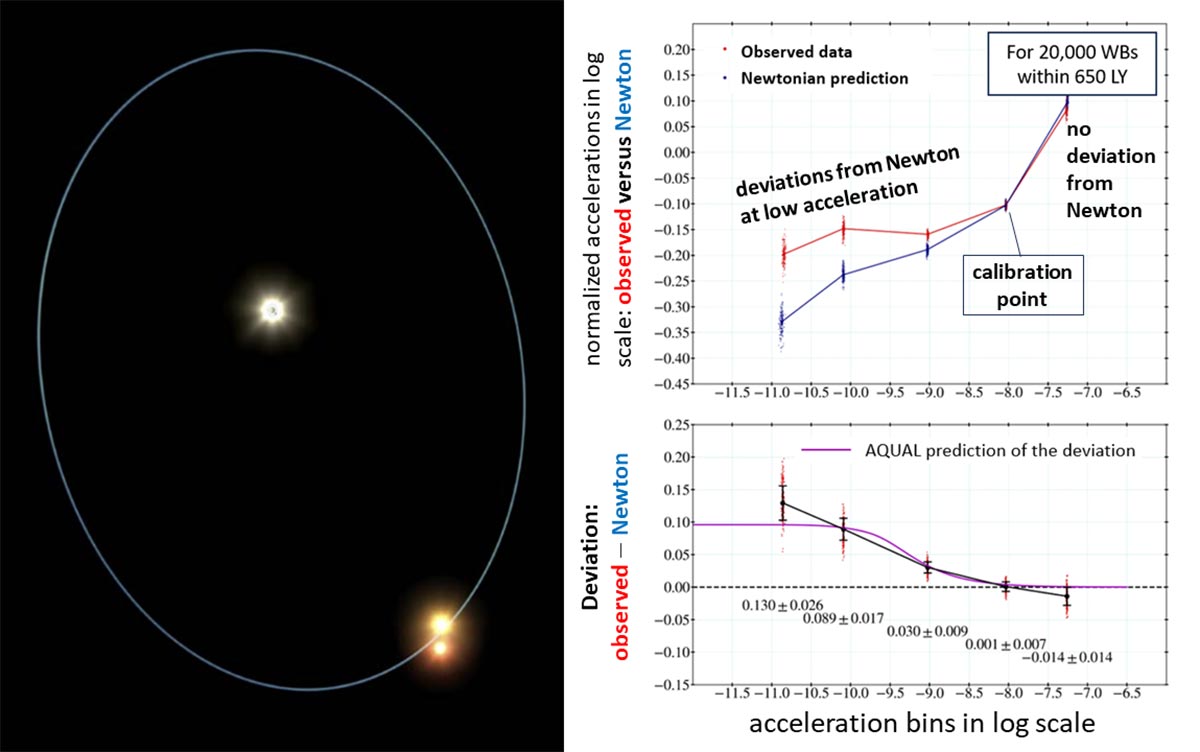
Left: A binary star system with a nested inner binary (credit: Wikipedia). Right: Gravitational anomaly at low acceleration observed in 20,000 wide binaries Credit: Kyu-Hyun Chae. (reblogged from SciTech Daily, blockquotes omitted)

A study on the orbital motions of wide binaries has uncovered evidence that standard gravity breaks down at low accelerations. This discovery aligns with a modified theory called MOND and challenges current concepts of dark matter. The implications for astrophysics, physics, and cosmology are profound, and the results have been acknowledged as a significant discovery by experts in the field.

A new study reports conclusive evidence for the breakdown of standard gravity in the low acceleration limit, stemming from a verifiable analysis of the orbital motions of long-period, widely separated binary stars. These stars are commonly referred to as wide binaries in astronomy and astrophysics. The study was carried out by Kyu-Hyun Chae, professor of physics and astronomy at Sejong University in Seoul, and it used up to 26,500 wide binaries within 650 light years (LY), observed by the European Space Agency’s Gaia space telescope.

Methodology

For a significant improvement over other research, Chae’s study concentrated on calculating the gravitational accelerations experienced by binary stars as a function of their separation or equivalently, the orbital period. This was achieved by a Monte Carlo deprojection of observed sky-projected motions to three-dimensional space.

Chae explains, “From the start, it seemed clear to me that gravity could be most directly and efficiently tested by calculating accelerations because the gravitational field itself is an acceleration. My recent research experiences with galactic rotation curves led me to this idea. Galactic disks and wide binaries share some similarity in their orbits, though wide binaries follow highly elongated orbits while hydrogen gas particles in a galactic disk follow nearly circular orbits.”

In addition, Chae calibrated the occurrence rate of hidden nested inner binaries at a benchmark acceleration, unlike other studies.

Findings

The study reveals that when two stars orbit each other with accelerations lower than about one nanometer per second squared, they start to deviate from predictions by Newton’s universal law of gravitation and Einstein’s general relativity. For accelerations lower than approximately 0.1 nanometer per second squared, the observed acceleration is about 30 to 40 percent higher than the Newton-Einstein prediction. The significance is considerable, meeting the conventional criteria of 5 sigma for a scientific discovery. In a sample of 20,000 wide binaries within a distance limit of 650 LY, two independent acceleration bins respectively show deviations of over 5 sigma significance in the same direction.

Because the observed accelerations stronger than about 10 nanometers per second squared agree well with the Newton-Einstein prediction from the same analysis, the observed boost of accelerations at lower accelerations is a mystery. Intriguingly, this breakdown of the Newton-Einstein theory at weaker accelerations was suggested 40 years ago by theoretical physicist Mordehai Milgrom at the Weizmann Institute in Israel in a new theoretical framework called modified Newtonian dynamics (MOND) or Milgromian dynamics in current usage.

Connection to MOND

The boost factor of about 1.4 is correctly predicted by a MOND-type Lagrangian theory of gravity called AQUAL, proposed by Milgrom and the late physicist Jacob Bekenstein. What’s remarkable is that the correct boost factor requires the external field effect from the Milky Way galaxy, a unique prediction of MOND-type modified gravity. Thus, the wide binary data indicate not only the breakdown of Newtonian dynamics but also the manifestation of the external field effect of modified gravity.

Chae’s Insight

On the results, Chae says, “It seems impossible that a conspiracy or unknown systematic can cause these acceleration-dependent breakdowns of the standard gravity in agreement with AQUAL. I have examined all possible systematics as described in the rather long paper. The results are genuine. I foresee that the results will be confirmed and refined with better and larger data in the future. I have also released all my codes for the sake of transparency and to serve any interested researchers.”

Implications and Limitations

Unlike galactic rotation curves, where the observed boosted accelerations can theoretically be attributed to dark matter in the Newton-Einstein standard gravity, wide binary dynamics cannot be affected by it even if it existed. The standard gravity simply breaks down in the weak acceleration limit in accordance with the MOND framework.

The implications of wide binary dynamics are profound for astrophysics, theoretical physics, and cosmology. Anomalies in Mercury’s orbits observed in the nineteenth century eventually led to Einstein’s general relativity. Now anomalies in wide binaries demand a new theory extending general relativity to the low acceleration MOND limit.

Despite all the successes of Newton’s gravity, general relativity is needed for relativistic gravitational phenomena such as black holes and gravitational waves. Likewise, despite all the successes of general relativity, a new theory is needed for MOND phenomena in the weak acceleration limit. The weak-acceleration catastrophe of gravity may have some similarity to the ultraviolet catastrophe of classical electrodynamics that led to quantum physics.

Revolution in Physics

Wide binary anomalies are disastrous for standard gravity and cosmology that rely on dark matter and dark energy concepts. Since gravity follows MOND, a large amount of dark matter in galaxies (and even in the universe) is no longer needed. This is a significant surprise to Chae who, like typical scientists, “believed in” dark matter until a few years ago.

A new revolution in physics seems now underway. On the present results and the future prospects, Milgrom says, “Chae’s finding is a result of a very involved analysis of cutting-edge data, which, as far as I can judge, he has performed very meticulously and carefully. But for such a far-reaching finding — and it is indeed very far-reaching — we require confirmation by independent analyses, preferably with better future data. If this anomaly is confirmed as a breakdown of Newtonian dynamics, and especially if it indeed agrees with the most straightforward predictions of MOND, it will have enormous implications for astrophysics, cosmology, and for fundamental physics at large.”

Peer Opinions

Xavier Hernandez, professor at UNAM in Mexico who first suggested wide binary tests of gravity a decade ago, says, “It is exciting that the departure from Newtonian gravity that my group has claimed for some time has now been independently confirmed, and impressive that this departure has for the first time been correctly identified as accurately corresponding to a detailed MOND model. The unprecedented accuracy of the Gaia satellite, the large and meticulously selected sample Chae uses and his detailed analysis, make his results sufficiently robust to qualify as a discovery.”

Pavel Kroupa, professor at Bonn University and at Charles University in Prague, has come to the same conclusions concerning the law of gravitation. He says, “With this test on wide binaries as well as our tests on open star clusters nearby the Sun, the data now compellingly imply that gravitation is Milgromian rather than Newtonian. The implications for all of astrophysics are immense.”

The finding was published in the 1 August 2023 issue of The Astrophysical Journal.

Reference: “Breakdown of the Newton–Einstein Standard Gravity at Low Acceleration in Internal Dynamics of Wide Binary Stars” by Kyu-Hyun Chae, 24 July 2023, The Astrophysical Journal. DOI: 10.3847/1538-4357/ace101

Update (2024): counter-argument, supporting evidence, further argument and review. Await further Gaia data releases.

First evidence that black holes are the source of dark energy

Posted in astronomy with tags , , , on March 23, 2023 by Tim Kendall

(Phys.org) Observations of supermassive black holes at the centers of galaxies point to a likely source of dark energy—the ‘missing’ 70% of the universe.

The measurements from ancient and dormant galaxies show black holes growing more than expected, aligning with a phenomenon predicted in Einstein’s theory of gravity. The result potentially means nothing new has to be added to our picture of the universe to account for dark energy: black holes combined with Einstein’s gravity are the source.

The conclusion was reached by a team of 17 researchers in nine countries, led by the University of Hawai’i and including Imperial College London and STFC RAL Space physicists. The work is published in two papers in the journals The Astrophysical Journal and The Astrophysical Journal Letters.

Study co-author Dr. Dave Clements, from the Department of Physics at Imperial, said, “This is a really surprising result. We started off looking at how black holes grow over time, and may have found the answer to one of the biggest problems in cosmology.”

Study co-author Dr. Chris Pearson, from STFC RAL Space, said, “If the theory holds, then this is going to revolutionize the whole of cosmology, because at last we’ve got a solution for the origin of dark energy that’s been perplexing cosmologists and theoretical physicists for more than 20 years.” (continues in depth)

Duncan Farrah et al, A Preferential Growth Channel for Supermassive Black Holes in Elliptical Galaxies at z ≲ 2, The Astrophysical Journal (2023). DOI: 10.3847/1538-4357/acac2e

The Astrophysical Journal Letters (2023). Observational Evidence for Cosmological Coupling of Black Holes and its Implications for an Astrophysical Source of Dark Energy DOI: 10.3847/2041-8213/acb704. iopscience.iop.org/article/10. … 847/2041-8213/acb704

Abstract: Observations have found black holes spanning 10 orders of magnitude in mass across most of cosmic history. The Kerr black hole solution is, however, provisional as its behavior at infinity is incompatible with an expanding universe. Black hole models with realistic behavior at infinity predict that the gravitating mass of a black hole can increase with the expansion of the universe independently of accretion or mergers, in a manner that depends on the black hole’s interior solution. We test this prediction by considering the growth of supermassive black holes in elliptical galaxies over 0 < z ≲ 2.5. We find evidence for cosmologically coupled mass growth among these black holes, with zero cosmological coupling excluded at 99.98% confidence. The redshift dependence of the mass growth implies that, at z ≲ 7, black holes contribute an effectively constant cosmological energy density to Friedmann’s equations. The continuity equation then requires that black holes contribute cosmologically as vacuum energy. We further show that black hole production from the cosmic star formation history gives the value of ΩΛ measured by Planck while being consistent with constraints from massive compact halo objects. We thus propose that stellar remnant black holes are the astrophysical origin of dark energy, explaining the onset of accelerating expansion at z ∼ 0.7.

In an unrelated, different finding dark matter may have been indirectly detected in 2 stellar mass black holes, by a phenomenon akin to viscous drag.

“Research team finds indirect evidence for existence of dark matter surrounding black holes”

Dark matter does not emit or reflect light, nor does it interact with electromagnetic forces, making it exceptionally difficult to detect. Nevertheless, a research team from The Education University of Hong Kong (EdUHK) has proven that there is a substantial amount of dark matter surrounding black holes. The study results are published in the journal The Astrophysical Journal Letters.

The team selected two nearby black holes (A0620-00 and XTE J1118+480) as research subjects, with both considered as binary systems. That is, each of the black holes has a companion star orbiting it. Based on the orbits of the companion stars, observations indicate that their rates of orbital decay are approximately one millisecond (1ms) per year, which is about 50 times greater than the theoretical estimation of about 0.02ms annually.

To examine whether dark matter exists around black holes, the EdUHK team applied the “dark matter dynamical friction model”—a theory widely held in academia—to the two chosen binary systems, through computer simulations. The team found that the fast orbital decay of the companion stars precisely matches the data observed.

Notably, this is indirect evidence that dark matter around black holes can generate significant dynamical friction, slowing down the orbital speed of the companion stars.

The findings, which verified a theoretical hypothesis formulated in the late 20th century, represent a breakthrough in dark matter research. According to the hypothesis, dark matter close enough to black holes would be swallowed, leaving the remnants to be redistributed. The process ends up forming a “density spike” around the black holes.

Dr. Chan Man-ho, Associate Professor in the Department of Science and Environmental Studies and Principal Investigator, explained that such a high density of dark matter would create dynamical friction to the companion star, in a way similar to drag force.

“This is the first-ever study to apply the ‘dynamical friction model’ in an effort to validate and prove the existence of dark matter surrounding black holes,” he said. “The study provides an important new direction for future dark matter research.” (continues)

Man Ho Chan et al, Indirect Evidence for Dark Matter Density Spikes around Stellar-mass Black Holes, The Astrophysical Journal Letters (2023). DOI: 10.3847/2041-8213/acaafa

Abstract: It has been suggested for a long time that dark matter would form a density spike around a black hole. However, no promising evidence has been observed so far to verify this theoretical suggestion. Here, we report the existence of a dark matter density spike around each of the two nearby stellar-mass black holes (A0620-00 and XTE J1118+480). The dynamical friction between dark matter and the companion stars can satisfactorily explain the abnormally fast orbital decays in the two binaries. The calculated spike index for A0620-00 and XTE J1118+480 is gamma = 1.71 (+0.02/-0.01) and gamma = 1.85 (+0.04/-0.04) respectively, which are close to the lower regime predicted by the stellar heating model. It may provide possible indirect evidence for the existence of dark matter density spikes around stellar-mass black holes. We anticipate that analyzing observational data of nearby black hole X-ray binaries would be a new way to reveal the nature of dark matter.

(Italics are mine). Lead image: elliptical galaxy Fornax A

Astronomers find missing link for water in the Solar System

Posted in astronomy with tags , on March 11, 2023 by Tim Kendall

(ESO) ALMA images of the disc around the star V883 Orionis, showing the spatial distribution of water (left, orange), dust (middle, green) and carbon monoxide (blue, right). Because water freezes out at higher temperatures than carbon monoxide, it can only be detected in gaseous form closer to the star. The apparent gap in the the water and carbon monoxide images is actually due to the bright emission of the dust, which attenuates the emission of the gas. Credit: ALMA (ESO/NAOJ/NRAO), J. Tobin, B. Saxton (NRAO/AUI/NSF)

Using the Atacama Large Millimeter/submillimeter Array (ALMA), astronomers have detected gaseous water in the planet-forming disc around the star V883 Orionis. This water carries a chemical signature that explains the journey of water from star-forming gas clouds to planets, and supports the idea that water on Earth is even older than our Sun.

We can now trace the origins of water in our Solar System to before the formation of the Sun,” says John J. Tobin, an astronomer at the National Radio Astronomy Observatory, USA and lead author of the study published today in Nature.

This discovery was made by studying the composition of water in V883 Orionis, a planet-forming disc about 1300 light-years away from Earth. When a cloud of gas and dust collapses it forms a star at its centre. Around the star, material from the cloud also forms a disc. Over the course of a few million years, the matter in the disc clumps together to form comets, asteroids, and eventually planets. Tobin and his team used ALMA, in which the European Southern Observatory (ESO) is a partner, to measure chemical signatures of the water and its path from the star-forming cloud to planets.

Water usually consists of one oxygen atom and two hydrogen atoms. Tobin’s team studied a slightly heavier version of water where one of the hydrogen atoms is replaced with deuterium — a heavy isotope of hydrogen. Because simple and heavy water form under different conditions, their ratio can be used to trace when and where the water was formed. For instance, this ratio in some Solar System comets has been shown to be similar to that in water on Earth, suggesting that comets might have delivered water to Earth.

The journey of water from clouds to young stars, and then later from comets to planets has previously been observed, but until now the link between the young stars and comets was missing. “V883 Orionis is the missing link in this case,” says Tobin. “The composition of the water in the disc is very similar to that of comets in our own Solar System. This is confirmation of the idea that the water in planetary systems formed billions of years ago, before the Sun, in interstellar space, and has been inherited by both comets and Earth, relatively unchanged.”

But observing the water turned out to be tricky. “Most of the water in planet-forming discs is frozen out as ice, so it’s usually hidden from our view,” says co-author Margot Leemker, a PhD student at Leiden Observatory in the Netherlands. Gaseous water can be detected thanks to the radiation emitted by molecules as they spin and vibrate, but this is more complicated when the water is frozen, where the motion of molecules is more constrained. Gaseous water can be found towards the centre of the discs, close to the star, where it’s warmer. However, these close-in regions are hidden by the dust disc itself, and are also too small to be imaged with our telescopes.

Fortunately, the V883 Orionis disc was shown in a recent study to be unusually hot. A dramatic outburst of energy from the star heats the disc, “up to a temperature where water is no longer in the form of ice, but gas, enabling us to detect it,” says Tobin.

The team used ALMA, an array of radio telescopes in northern Chile, to observe the gaseous water in V883 Orionis. Thanks to its sensitivity and ability to discern small details they were able to both detect the water and determine its composition, as well as map its distribution within the disc. From the observations, they found this disc contains at least 1200 times the amount of water in all Earth’s oceans.

In the future, they hope to use ESO’s upcoming Extremely Large Telescope and its first-generation instrument METIS. This mid-infrared instrument will be able to resolve the gas-phase of water in these types of discs, strengthening the link of water’s path all the way from star-forming clouds to solar systems. ”This will give us a much more complete view of the ice and gas in planet-forming discs,” concludes Leemker.

Journal reference: Tobin, J.J., van ’t Hoff, M.L.R., Leemker, M. et al. Deuterium-enriched water ties planet-forming disks to comets and protostars. Nature, 2023 DOI: 10.1038/s41586-022-05676-z

Study reveals complex chemistry inside ‘stellar nurseries’

Posted in astronomy with tags , , on February 7, 2023 by Tim Kendall

(Phys.org) This mosaic combines several observations of the Taurus Molecular Cloud performed by ESA’s Herschel observatory. Located about 450 light-years from us, in the constellation Taurus, the Bull, this vast complex of interstellar clouds is where a myriad of stars are being born, and is the closest large region of star formation. Credit: ESA/Herschel/NASA/JPL-Caltech; acknowledgement: R. Hurt (JPL-Caltech),CC BY-SA 3.0 IGO

An international team of researchers has uncovered what might be a critical step in the chemical evolution of molecules in cosmic “stellar nurseries.” In these vast clouds of cold gas and dust in space, trillions of molecules swirl together over millions of years. The collapse of these interstellar clouds eventually gives rise to young stars and planets.

Like human bodies, stellar nurseries contain a lot of organic molecules, which are made up mostly of carbon and hydrogen atoms. The group’s results, published Feb. 6 in the journal Nature Astronomy, reveal how certain large organic molecules may form inside these clouds. It’s one tiny step in the eons-long chemical journey that carbon atoms undergo—forming in the hearts of dying stars, then becoming part of planets, living organisms on Earth and perhaps beyond.

“In these cold molecular clouds, you’re creating the first building blocks that will, in the end, form stars and planets,” said Jordy Bouwman, research associate at the Laboratory for Atmospheric and Space Physics (LASP) and assistant professor in the Department of Chemistry at the University of Colorado Boulder.

For the new study, Bouwman and his colleagues took a deep dive into one stellar nursery in particular: the Taurus Molecular Cloud (TMC-1). This region sits in the constellation Taurus and is roughly 440 light years (more than 2 quadrillion miles) from Earth. This chemically complex environment is an example of what astronomers call an “accreting starless core.” Its cloud has begun to collapse, but scientists haven’t yet detected embryonic stars emerging inside it.

The team’s findings hinge on a deceptively simple molecule called ortho-benzyne. Drawing on experiments on Earth and computer simulations, the researchers showed that this molecule can readily combine with others in space to form a wide range of larger organic molecules. (continues)

Research publication: Jordy Bouwman, Five-membered ring compounds from ortho-benzyne + methyl radical reaction under interstellar conditions, Nature Astronomy (2023). DOI: 10.1038/s41550-023-01893-2. www.nature.com/articles/s41550-023-01893-2

Some more relatively recent developments in the field of astrochemistry:

Ingredients for Life Appear in Stellar Nurseries Long Before Stars are Born

Lab produces building blocks to DNA and RNA in deep space conditions

Complex organic molecules detected in the starless core Lynds 1521E

Webb unveils dark side of pre-stellar ice chemistry

Posted in astronomy with tags , , , on January 28, 2023 by Tim Kendall

(Phys.org) NIRSpec FS (NIRCam WFSS) and MIRI LRS spectra of NIR38 and J110621. Credit: Nature Astronomy (2023). DOI: 10.1038/s41550-022-01875-w

This image by the NASA/ESA/CSA James Webb Space Telescope’s Near-InfraRed Camera (NIRCam) features the central region of the Chameleon I dark molecular cloud, which resides 630 light years away. The cold, wispy cloud material (blue, centre) is illuminated in the infrared by the glow of the young, outflowing protostar Ced 110 IRS 4 (orange, upper left). The light from numerous background stars, seen as orange dots behind the cloud, can be used to detect ices in the cloud, which absorb the starlight passing through them. Credit: NASA, ESA, CSA, and M. Zamani (ESA/Webb); Science: F. Sun (Steward Observatory), Z. Smith (Open University), and the Ice Age ERS Team.

The discovery of diverse ices in the darkest regions of a cold molecular cloud measured to date has been announced by an international team of astronomers using NASA’s James Webb Space Telescope. This result allows astronomers to examine the simple icy molecules that will be incorporated into future exoplanets, while opening a new window on the origin of more complex molecules that are the first step in the creation of the building blocks of life.

If you want to build a habitable planet, ices are a vital ingredient because they are the main source of several key elements—namely carbon, hydrogen, oxygen, nitrogen, and sulfur (referred to here as CHONS). These elements are important ingredients in both and molecules like sugars, alcohols, and simple amino acids.

An international team of astronomers using NASA’s James Webb Space Telescope has obtained an in-depth inventory of the deepest, coldest ices measured to date in a molecular cloud. In addition to simple ices like water, the team was able to identify frozen forms of a wide range of molecules, from carbonyl sulfide, ammonia, and methane, to the simplest complex organic molecule, methanol. (The researchers considered to be complex when having six or more atoms.)

This is the most comprehensive census to date of the icy ingredients available to make future generations of stars and planets, before they are heated during the formation of young stars.

“Our results provide insights into the initial, dark chemistry stage of the formation of ice on the interstellar dust grains that will grow into the centimeter-sized pebbles from which planets form in disks,” said Melissa McClure, an astronomer at Leiden Observatory in the Netherlands, who is the principal investigator of the observing program and lead author of the paper describing this result.

“These observations open a new window on the formation pathways for the simple and that are needed to make the building blocks of life.”

In addition to the identified molecules, the team found evidence for molecules more complex than methanol, and, although they didn’t definitively attribute these signals to specific molecules, this proves for the first time that complex molecules form in the icy depths of molecular clouds before stars are born.

“Our identification of complex organic molecules, like methanol and potentially ethanol, also suggests that the many star and planetary systems developing in this particular cloud will inherit molecules in a fairly advanced chemical state,” added Will Rocha, an astronomer at Leiden Observatory who contributed to this discovery.

“This could mean that the presence of precursors to prebiotic molecules in is a common result of star formation, rather than a unique feature of our own solar system.” (continues)

“Dark” in this context being shorthand for “regions of sufficient density to shield molecular material from energetic ultraviolet radiation which would otherwise destroy chemical bonds”; the same precise meaning as in dark molecular clouds. These observations are of the ices in a dark molecular cloud in a pristine state, before the onset of star and planet formation. Ices containing carbon, hydrogen, oxygen, nitrogen and sulphur are detected using absorption spectroscopy, and abundances of between about 0.1% and 30% compared to water ice are measured.

Journal Reference: Melissa McClure, An Ice Age JWST inventory of dense molecular cloud ices, Nature Astronomy (2023) DOI: 10.1038/s41550-022-01875-w. www.nature.com/articles/s41550-022-01875-w

Images capture 850-year-old aftermath of stellar collision

Posted in astronomy with tags , on January 15, 2023 by Tim Kendall

(Phys.org) The unusual fireworks-like structure of nebula Pa 30 may result from the merger of two dying stars. Credit: Robert Fesen.

A Dartmouth professor’s images of the explosive aftermath from the collision of two dying stars could help scientists better understand this rare type of astronomical event—and may finally confirm the identity of a brilliant but short-lived star observed nearly 850 years ago.

Robert Fesen, a professor of physics and astronomy, captured telescopic images that show a fireworks-like burst of thin filaments radiating from a highly unusual star at the center of an object called Pa 30, according to findings he announced Jan. 12 at the 241st Meeting of the American Astronomical Society. Fesen is lead author of a paper reporting the findings that has been submitted to the The Astrophysical Journal Letters for publication.

Pa 30 is a dense region of illuminated gas, dust and other matter known as a nebula. Fesen and his co-authors report that Pa 30 appears to contain little to no hydrogen and helium but is instead rich in the elements of sulfur and argon.

The nebula’s unusual structure and characteristics match the predicted result of a collision between end-stage stars known as white dwarfs, Fesen said. White dwarfs are faint, extremely dense stars about the size of Earth that contain the mass of the Sun. The merger of two white dwarfs is one proposed explanation for a subclass of supernovae—or star explosions—called Iax events, in which the star is not completely destroyed, Fesen said.

“I have never seen any object—and certainly no supernova remnant in the Milky Way galaxy—that looks quite like this, and neither have any of my colleagues,” Fesen said. “This remnant will allow astronomers to study a particularly interesting type of supernova that up to now they could only investigate from theoretical models and examples in distant galaxies.”

The size of Pa 30 and the speed at which it is expanding—about 2.4 million miles per hour—suggest the explosive collision occurred around the year 1181, the researchers report. That coincides with observations by Chinese and Japanese astronomers at the time of a very bright star that suddenly appeared in the constellation Cassiopeia and was visible for about six months as it slowly faded. These fleeting stars are known as “guest stars.”

The images Fesen captured of the nebula’s structure and luminosity not only provide the most accurate estimate yet of its age, but also could allow astronomers to refine existing models of white dwarf mergers. Pa 30 was discovered in 2013 by co-author and amateur astronomer Dana Patchick, but up until now, images of the nebula had shown only an extremely faint and diffuse object, Fesen said.

“Our deeper images show that Pa 30 is not only beautiful, but now that we can see the nebula’s true structure, we can investigate its chemical makeup and how the central star generated its remarkable appearance, then compare these properties to predictions from specific models of rare white dwarf mergers,” Fesen said.

Fesen took the images of Pa 30 in late 2022 using the 2.4-meter Hiltner Telescope at the MDM Observatory—which Dartmouth owns and operates with four other universities—adjacent to Kitt Peak National Observatory in Arizona. Fesen equipped the telescope with an optical filter sensitive to a particular emission line of sulfur. He captured Pa 30 in three 2,000-second exposures under very clear skies and took additional data on the nebula’s structure, size and velocity.

The study by Fesen and his co-authors built upon work published in 2019 by Russian researchers who found an extremely unusual star nearly in the dead center of Pa 30. That star exhibited several properties suggesting the collision of two white dwarfs, and it had a surface temperature of nearly 400,000 degrees Fahrenheit with an astounding outflowing wind velocity of about 35 million miles per hour. (continues)

New hints that dark matter could be made up of dark photons

Posted in astronomy with tags , , on December 20, 2022 by Tim Kendall

Image: 2D projection of the cosmic web as obtained from a supercomputer simulation. Credit: Dr Ewald Puchwein and the Sherwood-Relics collaboration.

A very interesting idea is proposed (via Phys.org) with evidence from the Cosmic Origins Spectrograph on HST:

Dark matter could be made up of ultralight dark photons that heated up our universe: this is a new scenario proposed in a study recently published in Physical Review Letters. This hypothesis, the authors say, is in excellent agreement with observations made by the Cosmic Origin Spectrograph (COS) on board the Hubble Space Telescope, which takes measurements of the “cosmic web”, the complex and tenuous network of filaments that fills the space between galaxies.

The data collected by COS suggest that the cosmic intergalactic filaments are hotter than predictions from hydrodynamical simulations of the standard model of structure formation.

“Since dark photons would be able to convert into low-frequency photons and heat up the cosmic structures,” the scientists explain “they could well explain the experimental information.” The study has been carried out by SISSA researchers in collaboration with researchers at Tel Aviv, Nottingham and New York Universities.

‘Dark photons are good candidate for dark matter’: “Dark photons are hypothetical new particles that are the force carriers for a new force in the dark sector, much like how the photon is the force carrier for electromagnetism,” the authors James S. Bolton (University of Notitngham), Andrea Caputo (CERN and Tel Aviv University), Hongwan Liu (New York University), and Matteo Viel (SISSA) explain.

“Unlike the photon, however, they can have mass. In particular, the ultralight dark photon—with a mass as small as twenty orders of magnitude less than that of the electron—is a good candidate for dark matter.”

Dark photons and regular photons are also expected to mix like the different types of neutrinos, allowing ultralight dark photon dark matter to convert into low-frequency photons. These photons will heat up the cosmic web but, unlike other heating mechanisms, based on astrophysical processes, such as star formation and galactic winds, this heating process is more diffuse and efficient also in regions that are not very dense (continues).

Bolton et al., Comparison of Low-Redshift Lyman-α Forest Observations to Hydrodynamical Simulations with Dark Photon Dark Matter, Physical Review Letters (2022). DOI: 10.1103/PhysRevLett.129.2111022

For more background a previous article is also worth reading, here.

Gas clouds across the universe are known to absorb the light produced by distant massive celestial objects, known as quasars. This light manifests as the so-called Lyman alpha forest, a dense structure composed of absorption lines that can be observed using spectroscopy tools.

Over the past decades, astrophysicists have been assessing the value of these absorption lines as a tool to better understand the universe and the relationships between cosmological objects. The Lyman alpha forest could also potentially aid the ongoing search for dark matter, offering an additional tool to test theoretical predictions and models.

Researchers at University of Nottingham, Tel-Aviv University, New York University, and the Institute for Fundamental Physics of the Universe in Trieste have recently compared low-redshift Lyman alpha forest observations to hydrodynamical simulations of the intergalactic medium and dark matter made up of dark photons, a renowned dark matter candidate.

Their paper, published in Physical Review Letters (PRL), builds on an earlier work by some members of their team, which compared simulations of the intergalactic medium (IGM) with Lyman-alpha forest measurements collected by the Cosmic Origins Spectrograph (COS) aboard the Hubble Space Telescope.

“In our analyses, we found that the simulation predicted line widths that were too narrow compared to the COS results, suggesting that there could be additional, noncanonical sources of heating occurring at low redshifts,” Hongwan Liu, Matteo Viel, Andrea Caputo and James Bolton, the researchers who carried out the study, told Phys.org.

The Lyman-alpha forest as observed in the spectrum of a distant quasar.

Spectacular images showcase Webb’s power

Posted in astronomy with tags , , on August 30, 2022 by Tim Kendall

Among all the things going on in this image from JWST of M74 is a clear view of the star cluster at the very centre of the nucleus of the galaxy. The galaxy itself is a textbook example of a spiral galaxy, 32 million l.y. or just less than 10 Mpc distant. The image, which is composed using data from the mid-infrared instrument MIRI, is also shown combined with the Hubble view, here.

This image from the James Webb Space Telescope shows the heart of M74, otherwise known as the Phantom Galaxy. Webb’s sharp vision has revealed delicate filaments of gas and dust in the grandiose spiral arms which wind outwards from the center of this image. A lack of gas in the nuclear region also provides an unobscured view of the nuclear star cluster at the galaxy’s center. Credit: ESA/Webb, NASA & CSA, J. Lee and the PHANGS-JWST Team

In this mosaic image stretching 340 light-years across, Webb’s Near-Infrared Camera (NIRCam) shows the Tarantula Nebula star-forming region in the Large Magellanic Cloud. Credits: NASA, ESA, CSA, STScI, Webb ERO Production Team. Compare the Hubble image here.

The STARFORGE star formation simulations

Posted in astronomy with tags , , on May 28, 2022 by Tim Kendall

This series of simulations may be among the first to come close to explaining naturally the origin of the stellar initial mass function. Including the physics of protostellar jets, and their feedback effects on the cloud, appears to be critical. From the STARFORGE website:

What sets the masses of stars? One of the key mysteries of star formation is the origin of the stellar initial mass function (IMF), i.e., how common stars of different masses are. The IMF is observed to be nearly universal in the Milky Way and its satellites, regardless of age or location in the galactic disk. Significant variations are only inferred in extreme environments, such as the cores of massive elliptical galaxies and the Central Molecular Zone of the Milky Way.

In this work we present a suite of simulations from the STARFORGE project with increasingly complex physics to untangle the role turbulence, magnetic field, jets, radiation, winds and supernovae play in setting the masses of stars. We find that radiative feedback plays a major role in quenching star formation and disrupting the cloud, in other words we need radiation for star formation to end without turning all the gas into stars. However, the most common stellar mass is predominantly set by protostellar jet physics. Meanwhile, the effect of stellar winds is minor, and supernovae occur too late to affect the IMF or quench star formation.

A key observation of the IMF is that it appears to change little in our Galaxy, even for [stellar] populations that formed in different environments. We ran another suite of simulations to investigate how the environment affects the IMF. We find the IMF is insensitive to the initial level of turbulence, cloud mass and cloud surface density, even though these parameters significantly shape the star formation history of the cloud. The characteristic stellar mass depends weakly on metallicity and the interstellar radiation field, which essentially set the average gas temperature. Finally, while turbulent driving and the level of magnetization strongly influences the star formation history, they only influence the relative frequency of the most massive stars. Overall the masses of stars appear to be insensitive to what their birth environment is like, which could explain the observed universality of the IMF.

The new paper is accessible (preprint pdf). The work is important, as previous theoretical models have only been able to reproduce distributions resembling the observed one for rather narrow sets of initial conditions. In past work, reasonable but over-simplified physical assumptions additionally suggested the IMF should be highly dependent on initial conditions. The new models appear to have surmounted both these problems, at the same time (my italics).

Update: “Stars determine their own masses” (Science Daily). The paper is now published in MNRAS: Dávid Guszejnov, Michael Y Grudić, Stella S R Offner, Claude-André Faucher-Giguère, Philip F Hopkins, Anna L Rosen. “Effects of the environment and feedback physics on the initial mass function of stars in the STARFORGE simulations”. Monthly Notices of the Royal Astronomical Society, 2022; DOI: 10.1093/mnras/stac2060


NASA’s SPHEREx for interstellar ices

Posted in astronomy with tags , , on March 27, 2022 by Tim Kendall

This new mission has come to my attention only recently and is an innovative all-sky infrared spectrophotometric survey covering out to 5 microns wavelength. I’ve written extensively in this blog and elsewhere about the importance of the interstellar ice bands and about the potential of the Webb telescope to do multi-object spectroscopy, but in truth Webb has too many jobs already and will only perform highly targeted observations. (Interestingly, I read that the Hubble telescope has only observed about 0.1% of the sky in 30 years). SPHEREx is a small telescope taking the opposite approach: observe everything, >10^8 points on the sky, each with about 20 data points every micron of wavelength. This is enough to recover the relatively broad ice bands. Full details are on the SPHEREx website; I quote from among the science cases:

Water ice and biogenic molecules: SPHEREx will be a game changer in resolving long-standing questions about the amount and evolution of key biogenic molecules (H2O, CO, CO2, and CH3OH) throughout all phases of star and planetary formation.

Molecular Clouds to Protoplanetary Disks: Molecular clouds contain the gas and compounds that give rise to protoplanetary disks and, ultimately, to planets. While ices within these molecular clouds are a repository for important elements, they are also sites of active chemistry. For example, hydrogenation and oxygenation reactions occur within these ices, as does the production of complex organic molecules resulting from the interaction of the ices with radiation.

However, the evolution of molecular clouds to protoplanetary disks is largely unknown, hampered primarily by the lack of spectra available for Galactic molecular clouds and protoplanetary disks. SPHEREx will remedy this by increasing by 100-fold the number of ice spectra available of molecular clouds, young stellar objects, and protoplanetary disks. Armed with the SPHEREx data, it will be possible to understand, in a statistically significant way, how ice content correlates with, among other factors, cloud density, internal temperature, presence or absence of embedded sources, external UV and X-ray radiation, elemental abundances (e.g., C/O ratio), gas-phase composition, and cosmic-ray ionization rate.

Caption: Simulated SPHEREx observations accurately reproduce synthetic input ice spectra. Left panel: A synthetic SPHEREx spectrum (dashed-orange line) of a K5 star seen through high extinction (Av=14) including simulated ice absorption features. Red bars indicate the corresponding end-of-mission Nyquist-sampled SPHEREx spectra generated by the simulator, including noise (measurement residuals in middle-left panel). We fitted the simulated SPHEREx ice features to estimate optical depths and column densities, creating the recovered spectrum (green), which agrees with the input spectrum to within 10%. Middle and Right panels: each input column density for both H2O and CO2 ice was simulated 100 times accounting for variation due to noise. The recovered column densities (purple, with 1-sigma uncertainties) are compared to the input column densities for sources seen by SPHEREx with SNRs of 100 on the continua. Fractional differences between the recovered and input column densities are shown in the bottom panels. 

Update: the SPHEREx website has disappeared; other links here, here, and here.

Astronomers Detect Largest Molecule Yet in a Cosmic “Dust-Trap”

Posted in astronomy with tags , , on March 22, 2022 by Tim Kendall

Using the Atacama Large Millimeter/submillimeter Array (ALMA) in Chile, researchers at Leiden Observatory in the Netherlands have for the first time detected dimethyl ether in a planet-forming disc. With nine atoms, this is the largest molecule identified in such a disc to date. It is also a precursor of larger (“prebiotic”) organic molecules and is a key discovery in the search for life’s origins.

“From these results, we can learn more about the origin of life on our planet and therefore get a better idea of the potential for life in other planetary systems. It is very exciting to see how these findings fit into the bigger picture,” says Nashanty Brunken, a Master’s student at Leiden Observatory, part of Leiden University, and lead author of the study published on March 8, 2022, in Astronomy & Astrophysics.

Dimethyl ether is an organic molecule commonly seen in star-forming clouds, but had never before been found in a planet-forming disc. The researchers also made a tentative detection of methyl formate, a complex molecule similar to dimethyl ether that is also a building block for even larger organic molecules.

“It is really exciting to finally detect these larger molecules in discs. For a while we thought it might not be possible to observe them,” says co-author Alice Booth, also a researcher at Leiden Observatory.

The molecules were found in the planet-forming disc around the young star IRS 48 (also known as Oph-IRS 48) with the help of ALMA, an observatory co-owned by the European Southern Observatory (ESO). IRS 48, located 444 light-years away in the constellation Ophiuchus, has been the subject of numerous studies because its disc contains an asymmetric, cashew-nut-shaped “dust trap.” This region, which likely formed as a result of a newly born planet or small companion star located between the star and the dust trap, retains large numbers of millimeter-sized dust grains that can come together and grow into kilometer-sized objects like comets, asteroids and potentially even planets.

Many complex organic molecules, such as dimethyl ether, are thought to arise in star-forming clouds, even before the stars themselves are born. In these cold environments, atoms and simple molecules like carbon monoxide stick to dust grains, forming an ice layer and undergoing chemical reactions, which result in more complex molecules. Researchers recently discovered that the dust trap in the IRS 48 disc is also an ice reservoir, harboring dust grains covered with this ice rich in complex molecules. It was in this region of the disc that ALMA has now spotted signs of the dimethyl ether molecule: as heating from IRS 48 sublimates the ice into gas, the trapped molecules inherited from the cold clouds are freed and become detectable [continues].

Reference: “A major asymmetric ice trap in a planet-forming disk: III. First detection of dimethyl ether” by Nashanty G. C. Brunken, Alice S. Booth, Margot Leemker, Pooneh Nazari, Nienke van der Marel and Ewine F. van Dishoeck, 8 March 2022, Astronomy and Astrophysics. DOI: 10.1051/0004-6361/202142981

Caption to Figure: These images from the Atacama Large Millimeter/submillimeter Array (ALMA) show where various gas molecules were found in the disc around the IRS 48 star, also known as Oph-IRS 48. The disc contains a cashew-nut-shaped region in its southern part, which traps millimeter-sized dust grains that can come together and grow into kilometer-sized objects like comets, asteroids and potentially even planets. Recent observations spotted several complex organic molecules in this region, including formaldehyde (H2CO; orange), methanol (CH3OH; green), and dimethyl ether (CH3OCH3; blue), the last being the largest molecule found in a planet-forming disc to date. The emission signaling the presence of these molecules is clearly stronger in the disc’s dust trap, while carbon monoxide gas (CO; purple) is present in the entire gas disc. The location of the central star is marked with a star in all four images. The dust trap is about the same size as the area taken up by the methanol emission, shown on the bottom left. Credit: ALMA (ESO/NAOJ/NRAO)/A. Pohl, van der Marel et al., Brunken et al.

From dust to protoplanets

Posted in astronomy with tags , , on March 21, 2022 by Tim Kendall

Computer artwork depicting two protoplanetary disks. These disks of gas and dust host planetesimals, the seeds of new planets. RIKEN astrophysicists have developed a model that explains how dust avoids falling toward the star long enough to coalesce to form kilometer-sized planetesimals. Credit: © Mark Garlick/Science Photo Library; SciTechDaily.

A key step in the formation of new planets may have been uncovered by a new theoretical model of a protoplanetary disk developed by a RIKEN astrophysicist and two collaborators that explains how dust in the disk overcomes a tendency to drift toward the star. By amassing in high-density regions, dust grains avoid drifting toward the star they are orbiting.

Planets are birthed from a swirling disk of dust and gas that surrounds a young star, but it is unclear how dust grains can grow into larger objects before they spiral inward toward the star.

In the classical theory of planet formation, minuscule dust particles collide and stick together to form centimeter-sized grains. These grains gradually build up to form kilometer-sized planetesimals, the first major step in producing a new planet.

But the dust grains feel a drag from the gas in the protoplanetary disk. This slows the dust grains down, so that they fall toward the star. The speed at which they fall increases as the dust grains grow larger.

Previous studies have suggested that this effect should prevent the grains from forming objects larger than a meter, which poses a major conundrum for astronomers. “Various mechanisms have been proposed to explain the formation of planetesimals, but they are still under debate,” notes Ryosuke Tominaga of the RIKEN Star and Planet Formation Laboratory.

Tominaga and two colleagues have now proposed a model that suggests a possible solution to this problem—small variations in the distribution of dust in the protoplanetary disk are quickly amplified into regions of high and low dust density.

In areas having slightly higher densities, dust coagulates more efficiently, and it forms larger clumps that drift toward the star more quickly. When these clumps meet smaller dust particles, they form regions of even higher dust density, accelerating grain growth. Meanwhile, the regions vacated by the large clumps end up with relatively low densities.

The team found that this positive feedback creates multiple bands of high and low dust density in the protoplanetary disk. These bands can arise in a matter of 10,000 years or so, a remarkably short time for such astronomical processes. These high-density areas are ideal sites for further aggregation, allowing planetesimals to form before the dust grains are pulled into the star.

“Unlike previous theories, this coagulation mechanism works even when there is far more gas than dust in the protoplanetary disk,” says Tominaga.

The team is now working on more-detailed models that include the formation and evolution of the disk itself, along with the eventual formation of planetesimals.

Reference: “Coagulation Instability in Protoplanetary Disks: A Novel Mechanism Connecting Collisional Growth and Hydrodynamical Clumping of Dust Particles” by Ryosuke T. Tominaga, Shu-ichiro Inutsuka and Hiroshi Kobayashi, 8 December 2021, The Astrophysical Journal. DOI: 10.3847/1538-4357/ac173a

Planetesimal rings as the cause of the Solar System’s planetary architecture

Posted in astronomy with tags , , , on December 31, 2021 by Tim Kendall
(Phys.org) This is the sharpest image ever taken by ALMA — sharper than is routinely achieved in visible light with the NASA/ESA Hubble Space Telescope. It shows the protoplanetary disc surrounding the young star HL Tauri. These new ALMA observations reveal substructures within the disc that have never been seen before and even show the possible positions of planets forming in the dark patches within the system. Credit: ALMA (ESO/NAOJ/NRAO)

Astronomers have managed to link the properties of the inner planets of our solar system with our cosmic history: with the emergence of ring structures in the swirling disk of gas and dust in which these planets were formed. The rings are associated with basic physical properties such as the transition from an outer region where ice can form where water can only exist as water vapor. The astronomers made use of a spread of simulation to explore different possibilities of inner planet evolution. Our solar system’s inner regions are a rare, but possible outcome of that evolution. The results have been published in Nature Astronomy.

The broad-stroke picture of planet formation around stars has been unchanged for decades. But many of the specifics are still unexplained—and the search for explanations an important part of current research. Now, a group of astronomers led by Rice University’s Andre Izidoro, which includes Bertram Bitsch from the Max Planck Institute for Astronomy, has found an explanation for why the inner planets in our solar system have the properties we observe.

The broad-stroke picture in question is as follows: Around a young star, a “protoplanetary disk” of gas and dust forms, and inside that disk grow ever-larger small bodies, eventually reaching diameters of thousands of kilometers, that is: becoming planets. But in recent years, thanks to modern observational methods, the modern picture of planet formation has been refined and changed in very specific directions.

The most striking change was triggered by a literal picture: The first image taken by the ALMA observation after its completion in 2014. The image showed the protoplanetary disk around the young star HL Tauri in unprecedented detail, and the most stunning details amounted to a nested structure of clearly visible rings and gaps in that disk.

As the researchers involved in simulating protoplanetary disk structures took in these new observations, it became clear that such rings and gaps are commonly associated with “pressure bumps,” where the local pressure is somewhat lower than in the surrounding regions. Those localized changes are typically associated with changes in disk composition, mostly in the size of dust grains (continues in detail).

The paper is published in Nature Astronomy by Andre Izidoro et al. The abstract states:

Astronomical observations reveal that protoplanetary disks around young stars commonly have ring- and gap-like structures in their dust distributions. These features are associated with pressure bumps trapping dust particles at specific locations, which simulations show are ideal sites for planetesimal formation. Here we show that our Solar System may have formed from rings of planetesimals—created by pressure bumps—rather than a continuous disk. We model the gaseous disk phase assuming the existence of pressure bumps near the silicate sublimation line (at T ~ 1,400 K), water snowline (at T ~ 170 K) and CO snowline (at T ~ 30 K). Our simulations show that dust piles up at the bumps and forms up to three rings of planetesimals: a narrow ring near 1 au, a wide ring between ~3–4 au and ~10–20 au and a distant ring between ~20 au and ~45 au. We use a series of simulations to follow the evolution of the innermost ring and show how it can explain the orbital structure of the inner Solar System and provides a framework to explain the origins of isotopic signatures of Earth, Mars and different classes of meteorites. The central ring contains enough mass to explain the rapid growth of the giant planets’ cores. The outermost ring is consistent with dynamical models of Solar System evolution proposing that the early Solar System had a primordial planetesimal disk beyond the current orbit of Uranus.

This is a composite image of the young star HL Tauri and its surroundings using data from ALMA (enlarged in box at upper right) and the NASA/ESA Hubble Space Telescope (rest of the picture). This is the first ALMA image where the image sharpness exceeds that normally attained with Hubble. Credit: ALMA (ESO/NAOJ/NRAO), ESA/Hubble and NASA. Acknowledgement: Judy Schmidt. Various versions of the Hubble image without the ALMA inset may also be found  here.

A wide planetary-mass companion to the young K0 dwarf BD+60 1417 discovered through the Citizen Science Project Backyard Worlds: Planet 9

Posted in astronomy with tags , , , on December 26, 2021 by Tim Kendall

A citizen scientist volunteer’s observation of a distant object has led to the identification of a new large planet or a small brown dwarf.

In 2018, Jörg Schümann, a volunteer with the Backyard Worlds: Planet 9 project, noticed an object that appeared to be moving with a star. Prior searches for exoplanets had missed the object because it was so distant from its host star, but in a new study, scientists show that it is likely a large planet or a small brown dwarf, a type of object that is not massive enough to burn hydrogen like true stars. Details about the new world are published today in The Astrophysical Journal.

“This star had been looked at by more than one campaign searching for exoplanet companions. But previous teams looked really close to the star,” said lead author Jackie Faherty, senior scientist in the American Museum of Natural History’s Department of Astrophysics and co-founder of the Backyard Worlds: Planet 9 project. “Because citizen scientists really liked the project, they found an object that many of these direct imaging surveys would have loved to have found, but they didn’t look far enough away from its host.”

Volunteers with Backyard Worlds search through nearly five years of digital images taken from NASA’s Wide-field Infrared Survey Explorer (WISE) mission to try to identify new worlds inside and outside of our solar system. Moving objects near Earth will appear to “jump” in the same part of the sky over the years, similar to an object “moving” in a flipbook. Users can then flag these objects for further study by scientists.

The new object is young and has a low mass, between 10 and 20 times the mass of Jupiter. This range overlaps with an important cutoff point—13 times the mass of Jupiter—which is sometimes used to distinguish planets from brown dwarfs. But scientists still aren’t sure how heavy planets can be, which can make relying on this cutoff challenging. “We don’t have a very good definition of the word ‘planet,’” said Faherty, who prefers the term “world.” 

Another defining feature is how objects form: planets form from material gathering in disks around stars, while brown dwarfs are born from the collapse of giant clouds of gas, similar to how stars form. But the physical properties of this new object do not provide any clues to its formation. “There are hints that maybe it’s more like an exoplanet, but there’s nothing conclusive yet. However, it is an outlier,” said Faherty. 

The object is also farther away from the star than expected based on its comparatively low mass—more than 1,600 times farther than the Earth is from the Sun. Few objects with such different masses from their host star have been found this far apart.

“You had an exoplanet community just staring so close to it,” said Faherty. “And we just pulled out a little, and we found an object. That makes me excited about what we might be missing in giant planets that might exist around these stars. Sometimes, you need to broaden your scope.”

Material: American Museum of Natural History

The abstract in full:

Through the Backyard Worlds: Planet 9 citizen science project we discovered a late-type L dwarf co-moving with the young K0 star BD+60 1417 at a projected separation of 37” or 1662 au. The secondary—CWISER J124332.12+600126.2 (W1243)—is detected in both the CatWISE2020 and 2MASS reject tables. The photometric distance and CatWISE proper motion both match that of the primary within ∼1σ and our estimates for a chance alignment yield a zero probability. Follow-up near-infrared spectroscopy reveals W1243 to be a very red 2MASS (JKs = 2.72), low surface gravity source that we classify as L6–L8γ. Its spectral morphology strongly resembles that of confirmed late-type L dwarfs in 10–150 Myr moving groups as well as that of planetary mass companions. The position on near- and mid-infrared color–magnitude diagrams indicates the source is redder and fainter than the field sequence, a telltale sign of an object with thick clouds and a complex atmosphere. For the primary we obtained new optical spectroscopy and analyzed all available literature information for youth indicators. We conclude that the Li i abundance, its loci on color–magnitude and color–color diagrams, and the rotation rate revealed in multiple TESS sectors are all consistent with an age of 50–150 Myr. Using our re-evaluated age of the primary and the Gaia parallax, along with the photometry and spectrum for W1243, we find Teff = 1303 ± 31 K, log g = 4.3 ± 0.17 cm s−2, and a mass of 15 ± 5 MJup. We find a physical separation of ∼1662 au and a mass ratio of ∼0.01 for this system. Placing it in the context of the diverse collection of binary stars, brown dwarfs, and planetary companions, the BD+60 1417 system falls in a sparsely sampled area where the formation pathway is difficult to assess.

The 10 parsec sample in the Gaia era

Posted in astronomy with tags , , , on July 11, 2021 by Tim Kendall

A new paper by C. Reylé et al. in the journal Astronomy & Astrophysics provides an up-to-date and definitive list of all objects in the Solar neighbourhood within 10 parsecs. Graphics such as the one above, together with the list in various formats can be downloaded from https://gruze.org/10pc/resources/. The paper itself is at https://doi.org/10.1051/0004-6361/202140985. I quote from the introduction and conclusions (italics are my own):

We provide a catalogue of all objects closer than 10 pc from the Sun. It contains 540 objects divided between 373 stars, including 20 confirmed white dwarfs and one candidate white dwarf, 85 confirmed and three candidate brown dwarfs, and 77 confirmed exoplanets in 339 systems made up of 69 binaries, 19 triplets, three quadruplets, and two quintuplets.

The latest addition to the 10 pc sample is the planet GJ 486 b (Trifonov et al. 2021), but the last free floating objects have been discovered using the WISE (Wide-field Infrared Survey Explorer; Wright et al. 2010) survey. The coolest and lowest- mass object WISEA J085510.74–071442.5, a >Y4-type ultra-cool dwarf, was discovered by Luhman (2014) as the result of significant data-mining, and we concur with the result of Kirkpatrick et al. (2021) that the 10 pc volume is probably still not complete for objects later than spectral type Y2. The distribution of these lowest mass objects will indicate the minimum mass cut-off for stellar formation; therefore, finding all objects in this local volume will provide an important constraint for formation mechanisms. In addition, as the latest addition attests, the discovery of planets and other components within known systems is on the increase as our detection ability improves. Hence, while we expect the number of very low mass objects, planets, and low mass components with 10 pc within systems to increase, we do not expect to add any more higher mass, isolated, earlier type objects to the 10 pc census.

Survival of complex organic molecules from dark clouds into the planet-forming disk in HD100546

Posted in astronomy with tags , , on May 11, 2021 by Tim Kendall

Image credit (phys.org, provided by Netherlands Research School for Astronomy): Composite image of the star HD100546 (right) with the methanol reservoir (left) in its warm part of the protoplanetary disk. Credit: ALMA/Booth et al. & ESO/NASA/ESA/Ardila et al.

HD100546 (a Herbig Ae/Be star), is known to host a planet, perhaps the largest known and represented by the orange dot on the right hand side of the image. Now methanol has been detected in the warm inner disk where the molecule, whose formation is thought to arise predominantly by hydrogenation of CO ice, should not be being formed. This is (I quote from the abstract) “strong evidence that at least some of the organic material survives the disk formation process and can then be incorporated into forming planets, moons and comets. Therefore, crucial pre-biotic chemical evolution already takes place in dark star-forming clouds.

The abstract in full:

Quantifying the composition of the material in protoplanetary disks is paramount to determining the potential for exoplanetary systems to produce and support habitable environments. A key complex organic molecule (COM) to detect is methanol (CH3OH). CH3OH primarily forms at low temperatures via the hydrogenation of CO ice on the surface of icy dust grains and is a necessary basis for the formation of more complex species like amino acids and proteins. We report the detection of CH3OH in a disk around a young, luminous A-type star HD100546. This disk is warm and therefore does not host a significant CO ice reservoir. We argue that the CH3OH cannot form in situ, and hence, this disk has likely inherited COMs rich ice from an earlier cold dark cloud phase. This is strong evidence that at least some of the organic material survives the disk formation process and can then be incorporated into forming planets, moons and comets. Therefore, crucial pre-biotic chemical evolution already takes place in dark star-forming clouds.

The paper is in preprint form and now pulished in Nature Astronomy by Alice S. Booth et al. In: Nature Astronomy, 2021. DOI: 10.1038/s41550-021-01352-w, www.nature.com/articles/s41550-021-01352-w.

A non-energetic mechanism for glycine formation in the interstellar medium

Posted in astronomy with tags , on December 8, 2020 by Tim Kendall

An international team of laboratory astrophysicists and astrochemical modellers has shown that glycine, the simplest amino acid and an important building block of life, can form under the harsh conditions that govern chemistry in space. The results have been published this week in Nature Astronomy and show that glycine and very likely other amino acids are formed in dense interstellar clouds, well before these transform into new stars and planets.

Comets are the most pristine material in our Solar System and reflect the molecular composition at the time our Sun and planets were just about to form from material chemically processed in the interstellar medium. The detection of glycine in the coma of comet 67P/Churyumov-Gerasimenko and in samples returned to Earth from the Stardust mission strongly hint for a prestellar origin of amino acids. Until recently, glycine formation was thought to occur through energetic radiation, setting clear constraints to the environment in which it can be formed. New results by scientists working in the Laboratory for Astrophysics at Leiden Observatory, the Netherlands, show that it is possible to form glycine on the surface of icy dust grains through ‘dark chemistry’.

‘Dark chemistry means chemistry without the need of energetic radiation’, says Sergio Ioppolo (Queen Mary University, London), lead author of the article that appeared this week in Nature Astronomy. ‘In the laboratory, we have simulated the conditions in dark interstellar clouds: 10-20 K cold dust particles are covered by thin layers of abundant ices – frozen CO, NH3, CH4 and H2O – and subsequently processed by impacting atoms causing precursor species to fragment and reactive intermediates to recombine.’ In this way, first methylamine was shown to form, a precursor species of glycine and also detected in the coma of the comet 67P. Using a unique ultra-high vacuum setup, equipped with a series of atomic beam lines and accurate diagnostic tools, Ioppolo and coworkers were able to show that also glycine can be formed. The presence of water ice is essential in this process.

‘The important conclusion from this work is that molecules that are considered building blocks of life already form at a stage that is well before the start of star and planet formation,’ says Harold Linnartz, Director of the Laboratory for Astrophysics at Leiden Observatory. ‘Such an early formation of glycine in the evolution of star-forming regions implies that this amino acid can be formed more ubiquitously in space and is preserved in the bulk of ice before inclusion in comets and planetesimals that make up the material from which ultimately planets are made.’

The experiments were performed under fully controlled laboratory conditions and show that a non-energetic surface formation path for glycine at low temperatures is possible, different from previous work that required UV radiation to produce this molecule. Astrochemical models support this finding and allow to extrapolate data obtained on a typical laboratory timescale of just one day to interstellar conditions, bridging millions of years. ‘From this, we find that low but substantial amounts of glycine can be formed in space with time,’ says Herma Cuppen (Radboud University, Nijmegen), who was responsible for some of the modelling studies presented in the Nature Astronomy publication.

‘Once formed, glycine can also become a precursor to other complex organic molecules’, concludes Sergio Ioppolo. ‘Following the same mechanism, in principle, other functional groups can be added to the glycine backbone, resulting in the formation of other amino acids, such as alanine and serine in dark clouds in space.’ In the end, this enriched organic molecular inventory is included in celestial bodies, like comets, and delivered to young planets, as happened to our Earth and many other planets.

Research publication: Ioppolo, S., Fedoseev, G., Chuang, KJ. et al. ‘A non-energetic mechanism for glycine formation in the interstellar medium’. Nat Astron (2020). https://doi.org/10.1038/s41550-020-01249-0. The image at top is a wide-field view of part of the Taurus molecular cloud complex, from the ESO Digitized Sky Survey.

MIRACLES: atmospheric characterization of directly imaged planets and substellar companions at 4-5 μm. II. Constraints on the mass and radius of the enshrouded planet PDS 70 b

Posted in astronomy with tags , on December 7, 2020 by Tim Kendall

The young (~5 Myr) T Tauri star PDS 70 is an emblematic object for the study of planetary formation. It holds a gapped circumstellar disk in which two embedded planets (PDS 70 b and c) have been directly imaged and show evidence for gas accretion through detection of H alpha emission. The atmospheric and circumplanetary characteristics of these accreting young planets remain poorly understood, and a previous study of the spectral energy distribution of PDS 70 b has suggested a possible combination of emission from a planet atmosphere and a circumplanetary disk. Using VLT/NACO, Stolker et al. report the first detection of PDS 70 b in the Brα and M’ filters as well as a tentative detection of PDS 70 c in Brα. PDS 70 b appears significantly redder than any previously imaged planets and brown dwarfs in the color (K-M’) – magnitude (M’) diagram. Fitting the resulting 1-5 um spectral energy distribution leads to a photospheric temperature Teff = 1193 +/- 20 K and a photospheric radius R = 3.0 +/- 0.2 R_J. In addition, by comparing the object’s luminosity with predictions from planet structure models, and taking into account the accretion luminosity as constrained by H alpha, the authors were able to constrain the mass of PDS 70 b to Mp ≈ 0.5–1.5 M_J and its physical radius to Rp ≈ 1–2.5 R_J. The discrepancy between the photospheric and planetary radii may indicate that the planet is embedded in an extended dusty environment, muting molecular features in the object’s spectrum, which implies that PDS 70 b not only accretes gas but is also continuously replenished by dust.

The paper is T. Stolker, G.-D. Marleau, G. Cugno, et al., 2020, A&A, 643, A13. Caption to the Figure:

Color–magnitude diagram of absolute magnitude M_M′ versus colour K–M′. The field objects are color-coded by M, L, and T spectral types (see discrete colorbar), the young and low-gravity objects are indicated with a gray square, and the directly imaged companions are labeled individually. PDS 70 b is highlighted with a red star. The blue and orange lines show the synthetic colors computed from the AMES-Cond and AMES-Dusty evolutionary tracks at an age of 5 Myr. Blackbody radiation curves are shown for 8 RJ, 4 RJ, and 2 RJ (black dashed lines, from top to bottom). The black arrows indicate the reddening by MgSiO3 grains with a mean radius of 0.1 and 1μm, and extinction A_M′ of 0.05 and 2 mag, respectively.

New clues to the origin of stellar masses

Posted in astronomy with tags , , , on December 12, 2019 by Tim Kendall

NGC 6334 submillimetre + optical imaging. Filament is highlighed in the rectangle shownCEA-Irfu: An international team led by the Astrophysics Department-AIM Laboratory of CEA-Irfu has just obtained new clues about the origin of the mass distribution of stars, combining observational data from the large interferometer ALMA and the APEX radio telescope operated by the European Southern Observatory (ESO) and the Herschel Space Observatory. Thanks to ALMA, the researchers have discovered in the Cat’s Paw Nebula (NGC 6334), located at about 5,500 light years distant, the presence of protostellar dense cores much more massive than those observed in the solar vicinity. Researchers have shown that there is a close link between the mass distribution of interstellar filaments and the mass distribution of stars. The density – or mass per unit length – of the parent filaments is the crucial parameter that controls the masses of newly-formed stars. This discovery provides a key clue to the origin of stellar masses. These results are published in three articles of the journal Astronomy & Astrophysics.

Stars are major building blocks of the Universe and the life of a star is almost entirely determined by its initial mass. But, the origin of the mass distribution of stars at birth – called the initial mass function by astronomers – is still an unresolved issue. It has long been thought that stars are formed by the collapse of more or less spherical interstellar clouds. But from 2009, the Herschel space observatory, observing in the far infrared and submillimeter, has allowed a fundamental breakthrough by revealing that stars are born mainly in dense filaments of cold gas. When these long filaments of gas, at a temperature of barely ~ 10 K (10 degrees above absolute zero), reach a critical density threshold of approximately 5 solar masses per light-year of length, the mass concentration becomes sufficient to form stars. By observing interstellar clouds in the solar neighborhood, the results of the Herschel satellite have shown that star-forming filaments are all about the same width, close to ~ 0.3 light-years. In these clouds, the characteristic mass of stars formed by fragmentation of filaments is approximately ~ 0.3 solar mass. The ALMA study focused on a massive star-forming region known as NGC 6334, also known as the Cat’s Paw Nebula, located approximately 5500 light years from Earth. This nebula was one of the first regions “photographed” by the ArTéMiS camera observing at the wavelength of 350 μm. The ArTéMiS image revealed that the main filament has a width of about 0.5 light-years, very similar to that measured with Herschel for filaments in the solar neighborhood. The mass per unit length of this filament – about 300 solar masses per light-year – is however more than twenty times higher than the line mass of most of the filaments observed in the solar neighborhood [continues].

The paper is “Probing fragmentation and velocity sub-structure in the massive NGC 6334 filament with ALMA”, Y. Shimajiri et al., A&A 632, A83, (2019).

ALMA captures a binary star in the act of formation

Posted in astronomy with tags , on October 18, 2019 by Tim Kendall

Image (ESO): Astronomers using ALMA have obtained an extremely high-resolution image showing two disks in which young stars are growing, fed by a complex pretzel-shaped network of filaments of gas and dust. Observing this remarkable phenomenon sheds new light on the earliest phases of the lives of stars and helps astronomers determine the conditions in which binary stars are born.

The two baby stars were found in the [BHB2007] 11 system – the youngest member of a small stellar cluster in the Barnard 59 dark nebula, which is part of the clouds of interstellar dust called the Pipe nebula. Previous observations of this binary system showed the outer structure. Now, thanks to the high resolution of the Atacama Large Millimeter/submillimeter Array (ALMA) and an international team of astronomers led by scientists from the Max Planck Institute for Extraterrestrial Physics (MPE) in Germany, we can see the inner structure of this object.

We see two compact sources that we interpret as circumstellar disks around the two young stars,” explains Felipe Alves from MPE who led the study.  A circumstellar disk is the ring of dust and gas that surrounds a young star. The star accrete matter from the ring to grow bigger. “The size of each of these disks is similar to the asteroid belt in our Solar System and the separation between them is 28 times the distance between the Sun and the Earth,” notes Alves.

The two circumstellar disks are surrounded by a bigger disk with a total mass of about 80 Jupiter masses, which displays a complex network of dust structures distributed in spiral shapes –  the pretzel loops. “This is a really important result,” stresses Paola Caselli, managing director at MPE, head of the Centre of Astrochemical Studies and co-author of the study. “We have finally imaged the complex structure of young binary stars with their feeding filaments connecting them to the disk in which they were born. This provides important constraints for current models of star formation.

The similarity of this observation to computer simulations of binary star formation is remarkable.

Amino acid ingredients detected originating from Enceladus

Posted in astronomy with tags , on October 7, 2019 by Tim Kendall

Saturnian moon Enceladus

New kinds of organic compounds, the ingredients of amino acids, have been detected in the plumes bursting from Saturn’s moon Enceladus. The findings are the result of the ongoing deep dive into data from NASA’s Cassini mission. Powerful hydrothermal vents eject material from Enceladus’ core, which mixes with water from the moon’s massive subsurface ocean before it is released into space as water vapor and ice grains. The newly discovered molecules, condensed onto the ice grains, were determined to be nitrogen- and oxygen-bearing compounds.

On Earth, similar compounds are part of chemical reactions that produce amino acids, the building blocks of life. Hydrothermal vents on the ocean floor provide the energy that fuels the reactions. Scientists believe Enceladus’ hydrothermal vents may operate in the same way, supplying energy that leads to the production of amino acids.

“If the conditions are right, these molecules coming from the deep ocean of Enceladus could be on the same reaction pathway as we see here on Earth. We don’t yet know if amino acids are needed for life beyond Earth, but finding the molecules that form amino acids is an important piece of the puzzle,” said Nozair Khawaja, who led the research team of the Free University of Berlin. His findings were published Oct. 2 in the Monthly Notices of the Royal Astronomical Society.

Although the Cassini mission ended in September 2017, the data it provided will be mined for decades. Khawaja’s team used data from the spacecraft’s Cosmic Dust Analyzer, or CDA, which detected ice grains emitted from Enceladus into Saturn’s E ring. The scientists used the CDA’s mass spectrometer measurements to determine the composition of organic material in the grains. The identified organics first dissolved in the ocean of Enceladus, then evaporated from the water surface before condensing and freezing onto ice grains inside the fractures in the moon’s crust, scientists found. Blown into space with the rising plume emitted through those fractures, the ice grains were then analyzed by Cassini’s CDA. The new findings complement the team’s discovery last year of large, insoluble complex organic molecules believed to float on the surface of Enceladus’ ocean. The team went deeper with this recent work to find the ingredients, dissolved in the ocean, that are needed for the hydrothermal processes that would spur amino acid formation.

“Here we are finding smaller and soluble organic building blocks – potential precursors for amino acids and other ingredients required for life on Earth,” said co-author Jon Hillier.

“This work shows that Enceladus’ ocean has reactive building blocks in abundance, and it’s another green light in the investigation of the habitability of Enceladus,” added co-author Frank Postberg.

The Cassini-Huygens mission is a cooperative project of NASA, the European Space Agency (ESA) and the Italian Space Agency. NASA’s Jet Propulsion Laboratory, a division of Caltech in Pasadena, California, manages the mission for NASA’s Science Mission Directorate, Washington. JPL designed, developed and assembled the Cassini orbiter. The radar instrument was built by JPL and the Italian Space Agency, working with team members from the U.S. and several European countries.

More information about Cassini can be found here:

https://solarsystem.nasa.gov/cassini

Clustering around massive young stellar objects: the case of MWC 1080

Posted in astronomy with tags , , , , on February 16, 2019 by Tim Kendall

MWC 1080 is a young star with about 8 times the mass of our Sun and about 10,000 times the luminosity of the Sun. It has an age of less than 1 Myr and distance ~2 kpc. MWC 1080 is embedded in a dark cloud and illuminates a bright nebulosity. Previous studies reported a handful of young low-mass stars associated with MWC 1080 and the massive star itself is binary. The object has been observed with high spatial resolution from the ground at CFHT using adaptive optics. (An alternative image, from the Palomar telescope, is here.)

The new adaptive optics observations reveal that the nebulosity is quite symmetric and is shaped like an hourglass viewed from its side. The color gradients (blue to red) visible in the adaptive optics image are typical signatures of scattered light and indicate that the hourglass is actually a hollow structure illuminated from within by MWC 1080. Fast bipolar outflows have removed cloud material along the axis of the hourglass and cleared the view to less massive stars associated with MWC 1080. The new observations suggest that up to 100 faint, young low-mass objects cluster around MWC 1080, i.e. ten times as many stars as had previously been assumed. The young star cluster has a diameter of 3 light years. Its stellar density is several hundred times higher than the stellar density near the Sun [my italics]. Still, astronomers expect the cluster to gradually dissolve over the next 10 to 20 million years. The cluster members will then become “free-floating” field stars. Image courtesy W. Brandner (University of Hawaii, IfA, HI, USA) L. Close (ESO/U. of Arizona, USA) and collaborators.

The 2008 paper concerning the young embedded cluster around MWC 1080 is here. The cluster includes ~30 members within ~30 arcseconds of MWC 1080 itself. This research followed an early study concerning clustering around Herbig Be stars, a class of B stars with circumstellar material including MWC 1080. The borderline between multiplicity and clustering at even younger stellar ages is a subject of ongoing and much more recent investigation, for example by R. Pomohaci et al. (2019) who have performed infrared adaptive optics observations at the ESO VLT to investigate binarity and higher-order multiplicity in a sample of 32 massive YSOs. MYSOs represent an earlier evolutionary stage than the Herbig Ae/Be stars. The origins of the most massive and luminous stars have long been the subject of debate, and it is as yet unclear if some, or many, might be formed by the collisional coalescence of less massive stars. Coalescence surely requires the prior existence of a densely clustered environment. I have published indirect spectroscopic evidence from two different, known MYSOs, which I have interpreted as due to clustering. Such clusters, if confirmed, would be examples of precursors to massive stars like MWC 1080, with associated and presumably coeval low mass stars.

An oddball galaxy devoid of dark matter

Posted in astronomy with tags , on January 27, 2019 by Tim Kendall

NASA: This large, fuzzy-looking galaxy is so diffuse that astronomers call it a “see-through” galaxy because they can clearly see distant galaxies behind it. The ghostly object, catalogued as NGC 1052-DF2, doesn’t have a noticeable central region, or even spiral arms and a disk, typical features of a spiral galaxy. But it doesn’t look like an elliptical galaxy, either. Even its globular clusters are oddballs: they are twice as large as typical stellar groupings seen in other galaxies. All of these oddities pale in comparison to the weirdest aspect of this galaxy: NGC 1052-DF2 is missing most, if not all, of its dark matter. Credits: NASA, ESA, and P. van Dokkum (Yale University).

This story from early last year has been recently treated by Scientific American and a paper by P. van Dokkum et al. is available at the Nature website. Update: Scientific American have provided a new article on dark matter, including the finding of a previously unknown and also dark matter-poor companion ultra-diffuse dwarf galaxy to the Milky Way. Antila 2 has likely been stripped of dark matter over many gravitational interactions with the Milky Way in the past.

Update: a new preprint gives a new distance measurement for a sister galaxy to NGC 1052-DF2, NGC 1052-DF4, sharing similar very low dark matter content, and over-luminous globular clusters. The new distance measurement to NGC 1052-DF4 would rule out distance errors as an explanation for the unusual properties of that particular galaxy.

Multi-object spectroscopy for astrochemistry with the James Webb Space Telescope

Posted in astronomy with tags , on January 10, 2019 by Tim Kendall

The microshutter array (MSA) on the NIRCam instrument of JWST. Each quadrant of the device is about the size of a postage stamp. Each shutter can be opened or closed by the application of a moving magnetic field. On the sky, multiplexed devices allow simultaneous spectroscopy of many objects. Most importantly, bright objects in the field can be masked intentionally by closing one or more shutters, and their light will neither saturate the detector nor contaminate spectra of the fainter sources of interest. Only the light from sources of interest falls on the detector, solving one of the main historical problems of any form of multi-object astronomical spectroscopy. The are many applications, for example in measuring the redshifts of large numbers of very distant galaxies, or the chemistry of young brown dwarfs and free-floating exoplanets in star clusters. A significant use, which I have also covered in a previous post, is direct study of the astrochemistry (pdf) taking place in molecular clouds in the interstellar medium. In this case the sources of interest are any stars in the background of molecular clouds, which are penetrated by infrared light. Solid-state, icy matter in clouds gives rise to observable spectroscopic absorption features in the infrared. Ice spectra covering the bands of  CO, CO2 and H2O longward of about 3 microns wavelength inform astrochemical models of ice on dust grains in the coldest regions (~10K) deep inside molecular clouds. These regions are shielded from the dissociative effects of ultraviolet light on molecules. Methanol (CH3OH) forms, and is thought to be a “seed” molecule for the formation of more complex organic molecules within these icy grain mantles. The MSA is led at STScI by Klaus Pontoppidan, who in 2003 used the VLT to provide the first unequivocal evidence for the presence of methanol ice in low-mass protostars. For an overview of the astrochemistry of dust, ice and gas, see here.

An easier-to-manufacture alternative to the delicate MSA is generally deployed on ground-based telescopes at visible wavelengths. This is a fibre-fed (pdf) spectrograph, which uses optical (pdf) fibres to transfer light from objects of interest to the detector. The mechanisms needed to move fibres into their exact positions are too cumbersome and heavy for launch into space. Conventional visible-light astronomy uses silicon CCDs as the detector, and these do not work in the infrared. IR detector technologies (pdf, pdf) are well-advanced though, and even a relatively small, 2 metre aperture (Hubble-sized) telescope in orbit, equipped with multi-object IR spectroscopic capability would be a formidable instrument, capable of advancing many areas of observational astronomy in the future*. If JWST proves the MSA technology, it could be replicated on two or more smaller aperture infrared-optimized telescopes in space. [An interesting new concept for a 0.45 metre aperture space telescope for spectroscopy of exoplanets and solar system bodies has recently been unveiled.] For astrochemistry, smaller missions would complement JWST by obtaining spectra of many of the relatively bright stars observed in infrared light as sightlines through ice-rich dark molecular clouds. The ice astrochemistry program formally proposed for JWST Early Release Science is named IceAge. The material in molecular clouds is the directly observable analogue of chemical conditions existing now and prior to the formation of the solar system, and, interestingly for example, correlations in the bulk composition of comet 67P and the solar-mass protostar IRAS 16293-2422 are hinted at in new research.

* Updates & caveats: The NASA Origins Space Telescope, in development, has these specifications to do spectroscopy. Detector technology forces the choice of 5 microns as lower-wavelength cutoff. Detectors designed to operate in the near infrared below 5 microns do not work at longer wavelengths. There is a suggestion also in this design that the 3 to 5 micron region may perhaps even be avoided in the future although it contains the strongest and most fundamental ice bands. Yet there are good physical and observational reasons for working at longer wavelengths, and the technology functions with somewhat decreasing efficiency out to 20 microns or so. [Major ground-based observatories also have capabilities at certain wavelength “windows” in the mid-infrared, governed by where atmospheric absorption is most limited.] Higher vibrational bands from solid state molecules are observed at 5 to 10 micron wavelengths (e.g. here, here) and observationally these are likely to prove to be the most accurate probes of the solid-state chemistry of galactic dark molecular clouds and star-forming material.

A menagerie of protoplanetary disks observed by ALMA

Posted in astronomy with tags on December 18, 2018 by Tim Kendall

(Phys.org): ALMA’s high-resolution images of nearby protoplanetary disks, which are results of the Disk Substructures at High Angular Resolution Project (DSHARP). Credit: ALMA (ESO/NAOJ/NRAO), S. Andrews et al.; NRAO/AUI/NSF, S. Dagnello

A team of astronomers has conducted ALMA’s first large-scale, high-resolution survey of protoplanetary disks, the belts of dust and gas around young stars. Known as the Disk Substructures at High Angular Resolution Project (DSHARP), this “Large Program” of the Atacama Large Millimeter/submillimeter Array (ALMA) has yielded stunning, high-resolution images of 20 nearby protoplanetary disks and given astronomers new insights into the variety of features they contain and the speed with which planets can emerge. The results of this survey will appear in a special focus issue of the Astrophysical Journal Letters.

Constraints on companions to nearby stars by proper motion anomalies

Posted in astronomy with tags , , , on November 28, 2018 by Tim Kendall

Both the Hipparcos satellite in the 90s and the recent Gaia mission measured the absolute position of stars to an accuracy measured in micro-arcseconds, and they also observed stars more than once. From space, enough positional accuracy can be obtained to measure the apparent or proper motion of the star on the sky as it is observed over the duration of the mission. Relatively nearby and bright stars with quite large proper motions were observed by both Hipparcos and Gaia, yielding a timeline of around 25 years over which to additionally deduce the long-term proper motion vector of the star. The proper motion anomaly is any difference between the individual measurements and the long-term measurement. Any regular variation of the anomaly with time may be caused by the orbital motion of unseen companions. I do not generally call attention to papers which have not yet been refereed but I will make an exception for this recent preprint by Pierre Kervella et al. which has exploited this technique and data by measuring the proper motion anomalies of a sample of the nearest stars to constrain the properties of any low-mass stellar, brown dwarf or giant exoplanet companions orbiting around them. While these measurements are not quite precise enough to probe the possible super-Earth planets detected in radial velocity measurements over similar time durations around Proxima or Barnard’s Star, they have confirmed the masses of several companions to other nearby stars already known from radial velocity or other techniques. Such cases of demonstrated agreement of independent techniques will be a big step forward in our knowledge of the nearest stellar systems. The image shows the proper motion of Barnard’s star, the largest of any star in the sky. The abstract of the new research states:

The census of stellar and substellar companions of nearby stars is largely incomplete, in particular towards the low mass brown dwarf and long-period exoplanets. It is however of fundamental importance for stellar and planetary formation and evolution mechanisms. We aim at characterizing the presence of physical companions of stellar and substellar mass orbiting nearby stars. Orbiting secondary bodies influence the proper motion (PM) of their parent star. Using the Hipparcos (Hip) and Gaia DR2 (GDR2) catalogs, we determine the long-term PM of each star. We then search for a proper motion anomaly (PMa) between the long-term PM and the GDR2 (or Hip) measurements, indicative of the presence of a secondary object. We present a catalog of the PMa of 6741 nearby stars located within 50 pc. A fraction of ~40% of these objects presents a PMa at a level of more than 2σ, and ~30% at more than 3σ. We present a few illustrations of the PMa analysis. We set upper limits of 0.1 – 0.2 MJup to potential planets of Proxima between 1 and 10 au and 2.5 MJup on any stable orbit. We confirm that Proxima is gravitationally bound to alpha Cen. We recover the masses of the known companions of eps Eri, eps Ind, Ross 614, GJ 229, tau Boo and beta Pic. We also detect a possible long-period planet of a few jovian masses orbiting tau Ceti. The combination of the GDR2 with Hipparcos and the very high accuracy of the derived PMa already enables to set valuable constraints on the binarity of nearby objects. The detection of tangential velocity anomalies at a level of σ(dVtan) = 1.1 m/s per parsec of distance is already possible with the GDR2. This opens the possibility to identify long period orbital companions otherwise inaccessible. The complementarity of Gaia, radial velocity and transit techniques already appears as remarkably powerful.

Design a site like this with WordPress.com
Get started